Factory Automation in Canada: From Legacy Equipment to Smart Systems
Canadian manufacturers rarely start with a blank slate. Most plants are built in layers. A packaging line installed in the late 1990s still runs beside a newer robotic cell. A reliable press brake speaks one protocol, while the plant’s ERP expects another. A wastewater treatment skid has a controller that nobody wants to touch because the last programmer retired eight years ago. That is the real texture of factory automation in Canada, not a glossy brochure version, but a practical, incremental push to get more output, better quality, and tighter traceability from equipment that was never designed to work as one system.
That mix of old and new shapes nearly every automation conversation. In Ontario, food processors need better lot tracking and washdown-ready controls. In Alberta and Saskatchewan, producers often look for rugged systems that can tolerate temperature swings, dust, and remote support constraints. In Quebec, advanced manufacturing shops may already have islands of high-end automation, but still struggle with plant-wide data flow. Across the country, labor availability, energy costs, compliance demands, and pressure from foreign competitors are forcing the issue. The question is not whether manufacturers should automate. The question is how to do it without disrupting production, overspending, or creating a system nobody on the floor can maintain.
Why legacy equipment still matters
There is a persistent myth that modernization begins by ripping everything out. In practice, that is almost never the best first move. Some legacy assets have decades of useful mechanical life left. Frames are solid, tooling is paid for, maintenance teams know the machines intimately, and the process itself may already be stable. What is missing is visibility, coordination, and control sophistication.
I have seen plants double down on full replacement when a more surgical approach would have delivered faster gains. A twenty-year-old conveyor line with intermittent jams may not need a replacement line. It may need sensors that are properly placed, drives that can report load and fault conditions, and a PLC program that handles speed synchronization instead of relying on manual tweaking. A stamping operation with quality drift may not need a new press. It may need closed-loop feedback, better recipe control, and a cleaner handoff between machine settings and production orders.
Legacy equipment becomes a liability when it creates unpredictable downtime, safety exposure, or dependency on obsolete components that cannot be sourced quickly. But many machines fall into a middle ground. They are mechanically sound, electrically dated, and digitally isolated. That is exactly where well-planned manufacturing automation can create value.
The Canadian case for modernization
The business case for industrial automation Canada is not only about replacing labor. That framing is too narrow, and in many facilities it is simply wrong. Automation often fills roles that are hard to staff consistently, especially on night shifts, in repetitive material handling, or in environments that are cold, wet, loud, or ergonomically punishing. It also protects margin in ways that are less visible but more durable.
A plant manager may care first about throughput. A quality manager may care about reducing rework and proving process control during audits. Finance may focus on scrap, overtime, and deferred capital. Maintenance wants fewer nuisance faults and less dependence on tribal knowledge. Good automation systems address all of those at once when they are designed around the process rather than around the hardware catalog.
Canada adds a few wrinkles. Utility costs vary by province. So do incentive programs and regulatory expectations. Long distances matter more than people outside the sector sometimes realize. A support call in the Greater Toronto Area is one thing. Supporting equipment in a remote northern location or a prairie operation several hours from the nearest integrator is another. That reality makes maintainability, remote diagnostics, and parts strategy far more important than they look during the sales phase.
Currency exposure also plays a role. Many controls platforms, robots, and servo systems are priced in U.S. Dollars or tied to international supply chains. A project that looks comfortable on paper can tighten quickly if lead times slip or exchange rates move. That is one reason experienced buyers in industrial automation solutions often favor staged rollouts over all-at-once programs.
What “smart systems” really mean on the plant floor
Smart systems are often described too vaguely. On the ground, they usually mean five practical capabilities: machines that sense more, controllers that decide faster, software that records context, networks that move information reliably, and teams that can act on what they see. If one of those pieces is missing, the system may be automated but not truly smart.
Consider a bottling line. A basic automated line can start, stop, and reject obvious defects. A smarter line can correlate fill-level drift with temperature changes, identify that one capping head is beginning to underperform, alert maintenance before a trend becomes a stoppage, and tie every production lot to a digital record that can be retrieved in minutes. That is not science fiction. It is disciplined integration of sensors, controls, HMI design, historian data, and process knowledge.
The same principle applies in metal fabrication, wood products, plastics, and automotive supply. Smart systems do not have to be flashy. Sometimes the smartest upgrade is a clean alarm structure that helps operators identify root causes instead of acknowledging the same generic fault fifteen times a shift. Sometimes it is adding edge data collection to a legacy machine so production rates and downtime reasons can finally be measured accurately. In many plants, the biggest leap is not autonomous robotics. It is moving from guesswork to usable information.
The awkward middle: integrating old controls with new expectations
This is where most projects either earn their return or lose it. Legacy machines often use proprietary protocols, outdated drives, undocumented wiring changes, or PLC logic that was modified piecemeal over years. Drawings may exist, but they are often one revision behind reality, sometimes by a decade. Operators know the workarounds. The challenge is translating that living process knowledge into a safer, more reliable automation framework.
A common misstep is underestimating discovery. Plants want a quote for a migration, but the actual first task is learning what is there. That means reviewing electrical panels, backup files, I/O counts, network topology, spare parts status, and interlocks between upstream and downstream equipment. It also means watching the process run. A line can look straightforward on a P&ID or single-line drawing and still behave very differently during changeovers, washdowns, startup, or shift handoffs.
The best industrial automation solutions treat this discovery phase as engineering, not paperwork. When teams skip it, surprises show up at the worst possible time, during commissioning, during a holiday shutdown, or after the original programmer is no longer available. I have watched plants lose two days because a “simple” retrofit uncovered field devices wired in ways that no schematic reflected. That kind of delay is expensive, but it is avoidable.
Where automation pays back fastest
Not every line deserves the same level of automation. A mature facility usually gets better returns by targeting bottlenecks and chronic failure points first. The strongest projects solve a specific pain that everyone on the floor recognizes.
These are the areas where factory automation most often produces fast, measurable gains:
- repetitive material handling that creates ergonomic strain or staffing gaps
- manual inspection steps with inconsistent quality outcomes
- batch processes with recipe errors or weak traceability
- packaging and palletizing operations that limit upstream output
- legacy lines with frequent unplanned downtime and poor diagnostics
Each of those cases can support a different technical answer. Material handling may justify conveyors, vision-guided robots, or autonomous mobile platforms depending on layout and variability. Inspection might call for machine vision, but only if the feature set and reject criteria are stable enough to train around. Batch processes benefit from recipe management, electronic records, and interlocked sequencing, especially in food, beverage, and chemicals. Packaging lines often gain from relatively modest synchronization improvements before robotics even enter the picture.
The point is not to automate everything. It is to automate the constraints that hold back the plant.
Controls architecture is where long-term value gets decided
Many buyers focus on the visible parts of automation, robots, screens, sensors, guarding, and new panels. Those matter, but the architecture behind them matters more over time. A system that performs well for six months but becomes painful to maintain is not a successful project.
Architecture decisions show up in small but consequential places. Does the plant standardize on one PLC family or tolerate three? Are naming conventions consistent across machines? Can maintenance staff retrieve backups without calling an outside programmer? Are alarms prioritized rationally, or does the HMI flood the operator during a fault? Can production data be trusted enough to support scheduling decisions? Is remote access secure and controlled, or a risky afterthought?
In Canadian manufacturing, where many sites operate with lean technical teams, maintainability often outweighs theoretical performance. A sophisticated automation systems design that only one specialist can support may be less valuable than a slightly simpler design the in-house team can troubleshoot at 2 a.m. In January.
That trade-off comes up often in servo applications and robot cells. Highly optimized motion can shave cycle time, but it can also increase tuning sensitivity and troubleshooting complexity. Sometimes the better answer is a robust, slightly slower process with higher uptime and easier support. Skilled integrators understand that performance on paper is not the same as performance over five years.
Data collection is useful only when the context is right
Manufacturers have heard for years that they need more data. The truth is they need cleaner data tied to decisions. I have walked into plants with dashboards on large screens showing OEE, throughput, and alarm counts, yet nobody trusted the numbers enough to act on them. The sensors were there, but downtime categories were inconsistent, manual overrides were invisible, and counters did not match production reality after rework or scrap events.
For data to matter, it has to reflect the process honestly. That usually means combining automated signals with carefully designed operator inputs. A line stop is not just a line stop. It might be a jam, a quality hold, a material shortage, a sanitation delay, or upstream starvation. If the system records all of those as the same event, management gets a false picture and improvement stalls.
The strongest manufacturing automation projects start with https://pastelink.net/86tovxm7 a question, not a dashboard. Are we losing time during changeovers? Which filler head causes the most rejects? Are stop reasons different by shift? Why does line speed fall after lunch on warm days? Once the question is clear, the instrumentation and reporting can be designed to answer it. That is when data begins to support process improvement instead of becoming a decorative layer.
Safety should lead the design, not trail it
Automation projects can tighten safety performance significantly, but only if safety is treated as part of the system from the start. Retrofits are especially risky because they often combine old mechanical hazards with new electrical and controls behavior. A new robot cell beside an old manual station can create confusing interactions if safeguarding and procedures are not coherent.
Canadian facilities also operate under provincial occupational health and safety frameworks, insurance requirements, and internal corporate standards that can vary widely. Experienced teams account for lockout procedures, access during maintenance, fault recovery methods, and human factors, not just code minimums. A guard that protects well but turns every minor reset into a ten-minute nuisance will eventually be bypassed. That is not a moral failing of the operator. It is usually a design failure.
Practical safety design balances protection with production reality. Safe speed, zone control, light curtains, interlocked access, and well-designed reset logic can reduce risk without crippling uptime. The details matter. So does training. When operators understand why a system behaves the way it does, they work with it instead of around it.
Robotics in Canada, useful, but not universal
Robotics gets a lot of attention because the visual payoff is obvious. A robot arm moving boxes or tending a machine looks like progress. Sometimes it is. Sometimes it is a distraction from simpler improvements with better returns.
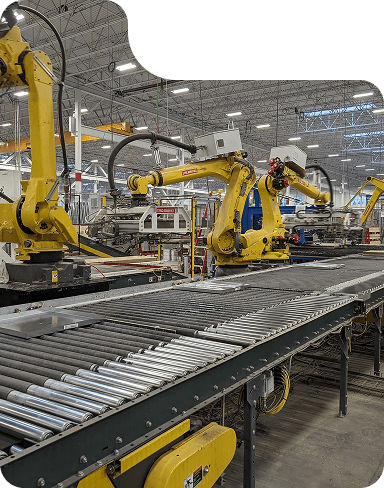
In Canadian plants, robotics tends to make the most sense where tasks are repetitive, cycle times are stable, and product variation is manageable. Palletizing is a classic example. Machine tending in CNC environments often works well. Welding can be a strong candidate if fixturing and part consistency are under control. Food applications demand more caution because sanitation, grippers, and product variability can complicate deployment.
A robot alone solves very little. Success depends on the surrounding cell, part presentation, end-of-arm tooling, safety integration, recovery logic, and operator interaction. The hard part is often not the robot path. It is everything around it. I have seen robot projects struggle because a low-cost infeed design starved the cell unpredictably. The robot was not the problem. The assumptions around it were.
That is why industrial automation Canada projects increasingly evaluate robotics within a broader flow design instead of as stand-alone capital. When the process around the robot is stable, the results are usually strong. When it is not, the cell exposes variation rather than eliminating it.
Choosing the right path: retrofit, partial replacement, or greenfield cell
There is no universal answer, but a few patterns tend to hold. Retrofitting makes sense when the mechanical platform is solid, the process is understood, and downtime windows are tight. Partial replacement works well when one subsystem is the weak point, such as controls, drives, or packaging equipment, while the rest of the line remains serviceable. A greenfield cell becomes attractive when safety, maintainability, and throughput constraints are too deeply embedded to fix cleanly.
A sensible evaluation usually weighs these factors:
- remaining mechanical life of the asset
- availability of spare parts and technical support
- production risk during installation and startup
- expected gain in throughput, quality, or labor flexibility
- internal ability to maintain the new system
That last factor gets overlooked. Plants often buy systems beyond their support model. If the site has one maintenance electrician per shift and no controls engineer, the automation strategy should reflect that reality. Otherwise, every fault becomes a vendor call, and the promised efficiency gains erode into support costs and frustration.
Commissioning is where plans meet reality
No matter how polished the design package looks, commissioning is where the truth comes out. Sensors need fine adjustment. Timing sequences need tuning. Operators reveal how the line is actually run, not how it was assumed to be run. Product variation appears. Shift-to-shift habits surface. If the integrator and plant team are not prepared for that learning phase, blame spreads quickly.
The most successful startups I have seen share a few traits. They schedule realistic time for dry testing and production validation. They involve maintenance and operators early, not only at handoff. They keep decision-makers available during startup so scope calls do not stall for twelve hours. And they document changes as they happen, not three weeks later when memory gets selective.
A brief anecdote illustrates the point. On one retrofit, a line that looked stable during day-shift testing began faulting repeatedly on the first night shift. The cause was not the new controls logic. It was a long-standing operator practice of clearing minor jams in a way that had never been documented because the old system tolerated it silently. The new safety and sequencing logic exposed the behavior immediately. Once the practice was understood, the team changed both the jam-clearing method and the HMI prompts. Startup stabilized after that. The lesson was simple: automation often reveals process truths that were always there.
What Canadian manufacturers should expect over the next few years
The direction is clear even if the pace varies. More plants will modernize through phased projects rather than full transformations. Demand for traceability, energy awareness, and production visibility will continue to rise. Controls migrations will remain common as older PLC platforms age out of support. Remote access and remote troubleshooting will become more disciplined, largely because cybersecurity can no longer be treated casually. Skilled labor constraints will keep pushing manufacturers toward automation, but the winners will be the ones that pair technology with process discipline and workforce training.
There is also a noticeable shift in what buyers ask for. Ten years ago, many clients wanted a machine to run. Now they also want that machine to explain itself. They want fault history, production context, maintenance prompts, and integration with business systems when it makes sense. That is a healthier expectation than chasing novelty. It reflects operational maturity.
Factory automation in Canada is not a single leap from old to new. It is a series of informed choices, often made under production pressure, budget limits, and staffing constraints. The best results come from respecting what legacy equipment still does well, being honest about what it cannot do, and designing smart systems that fit the plant’s real operating environment. When that happens, modernization stops being a slogan. It becomes a measurable improvement in how the factory runs every day.
Sync Robotics Inc. — Business Info (NAP)
Name: Sync Robotics Inc.Address: 2-683 Dease Rd, Kelowna, BC V1X 4A4
Phone: +1-250-753-7161
Website: https://www.syncrobotics.ca/
Email: [email protected]
Sales Email: [email protected]
Hours:
Monday: 8:00 AM – 4:30 PM
Tuesday: 8:00 AM – 4:30 PM
Wednesday: 8:00 AM – 4:30 PM
Thursday: 8:00 AM – 4:30 PM
Friday: 8:00 AM – 4:30 PM
Saturday: Closed
Sunday: Closed
Service Area: Kelowna, British Columbia and across Canada
Open-location code (Plus Code): VHWR+PQ Kelowna, British Columbia
Map/listing URL: https://maps.app.goo.gl/xwtV2wEu8ZuKH3se8
Embed iframe:
Socials (canonical https URLs):
LinkedIn: https://www.linkedin.com/company/syncrobotics/
Instagram: https://www.instagram.com/syncrobotics/
Facebook: https://www.facebook.com/syncrobotics/
https://www.syncrobotics.ca/
Sync Robotics Inc. is an industrial robot and controls integration company based in Kelowna, British Columbia.
The company designs and deploys automation solutions for manufacturing operations across Canada.
Services include industrial robotics integration, controls integration, automation system design, deployment support, and related manufacturing automation solutions.
Sync Robotics Inc. is located at 2-683 Dease Rd, Kelowna, BC V1X 4A4.
To contact Sync Robotics Inc., call +1-250-753-7161 or email [email protected].
For sales inquiries, email [email protected].
Hours listed are Monday to Friday 8:00 AM–4:30 PM, with Saturday and Sunday closed.
For directions and listing details, use the map listing: https://maps.app.goo.gl/xwtV2wEu8ZuKH3se8
Popular Questions About Sync Robotics Inc.
What does Sync Robotics Inc. do?Sync Robotics Inc. designs and deploys industrial robot and controls integration solutions for manufacturing operations.
Where is Sync Robotics Inc. located?
Sync Robotics Inc. is located at 2-683 Dease Rd, Kelowna, BC V1X 4A4.
Does Sync Robotics Inc. serve clients outside Kelowna?
Yes—Sync Robotics Inc. is based in Kelowna, British Columbia and serves clients across Canada.
What are Sync Robotics Inc.’s hours?
Monday–Friday: 8:00 AM–4:30 PM; Saturday and Sunday closed.
How can I contact Sync Robotics Inc.?
Phone: +1-250-753-7161
General Email: [email protected]
Sales Email: [email protected]
Website: https://www.syncrobotics.ca/
Map: https://maps.app.goo.gl/xwtV2wEu8ZuKH3se8
LinkedIn: https://www.linkedin.com/company/syncrobotics/
Instagram: https://www.instagram.com/syncrobotics/
Facebook: https://www.facebook.com/syncrobotics/
Landmarks Near Kelowna, BC
1) Kelowna International Airport2) UBC Okanagan
3) Rutland
4) Orchard Park Shopping Centre
5) Mission Creek Regional Park
6) Downtown Kelowna
7) Waterfront Park